
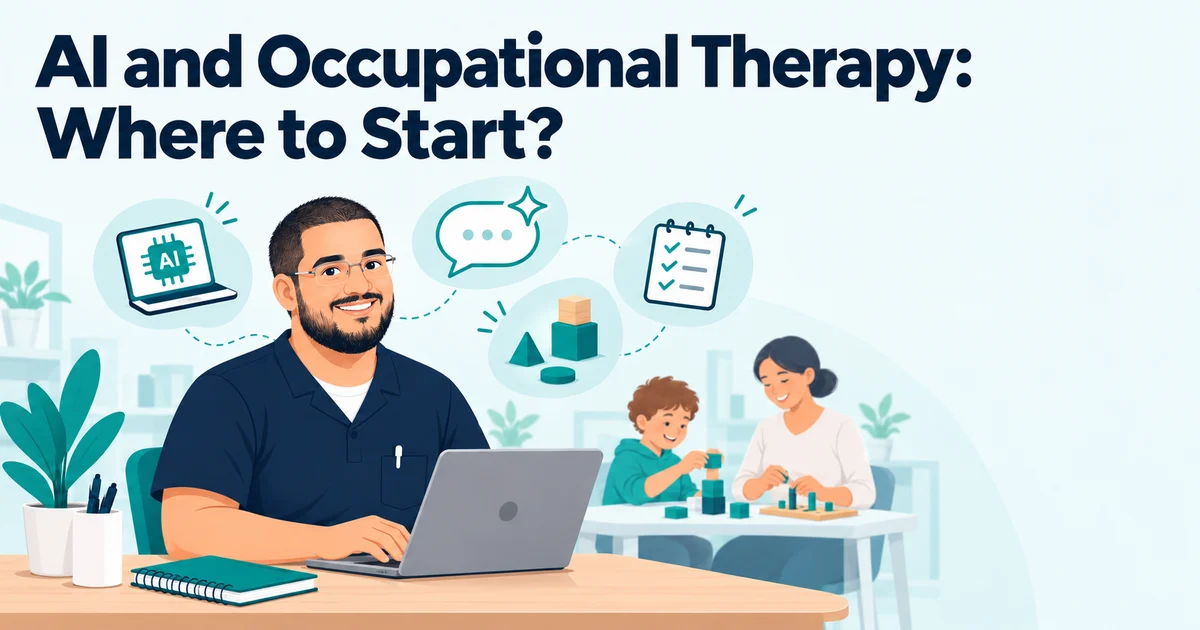
You do not need a technical background to use artificial intelligence in your occupational therapy practice: start with one small, precise task, and keep control of the result.
Why AI matters for occupational therapy
Occupational therapy starts from activity, participation and the person in their environment. AI touches exactly these areas: communication aids, adapted materials, games and immersive environments, writing support. It replaces neither clinical reasoning nor the therapeutic relationship; it frees up time and widens the options for adaptation.
Five practical first uses
- Prepare adapted materials: simplified texts, pictograms, social stories and illustrated instructions, to be reviewed and adjusted with the client.
- Save time on paperwork: report templates and letter rewording, using anonymised information only.
- Create tailored activities: games, quizzes and role-play scenarios fitted to the person’s goals and interests.
- Explore immersive technologies: virtual and augmented reality as a mediation, within a clear clinical framework.
- Learn and keep up: summarise articles, prepare a presentation, structure a literature review, always checking the sources.
Precautions to keep in mind
Health data is sensitive: never enter identifying information into a general-purpose tool. An AI answer can be wrong or biased, so every output is reviewed and validated by the therapist. Finally, the tool must serve a clinical goal, not the other way round.
Where to start
Pick one repetitive task from your week, test it on a fictional or anonymised case, note what works, and only then widen the scope. A simple habit beats one more tool.
Going further
I gathered these ideas in a practical guide for occupational therapists, AI, game creation and immersive technologies, and in the video course Artificial Intelligence & Occupational Therapy, available in French, English and Arabic.